Sister project · the engine
WebToe A node-based dataflow engine for real-time visuals, in the browser.
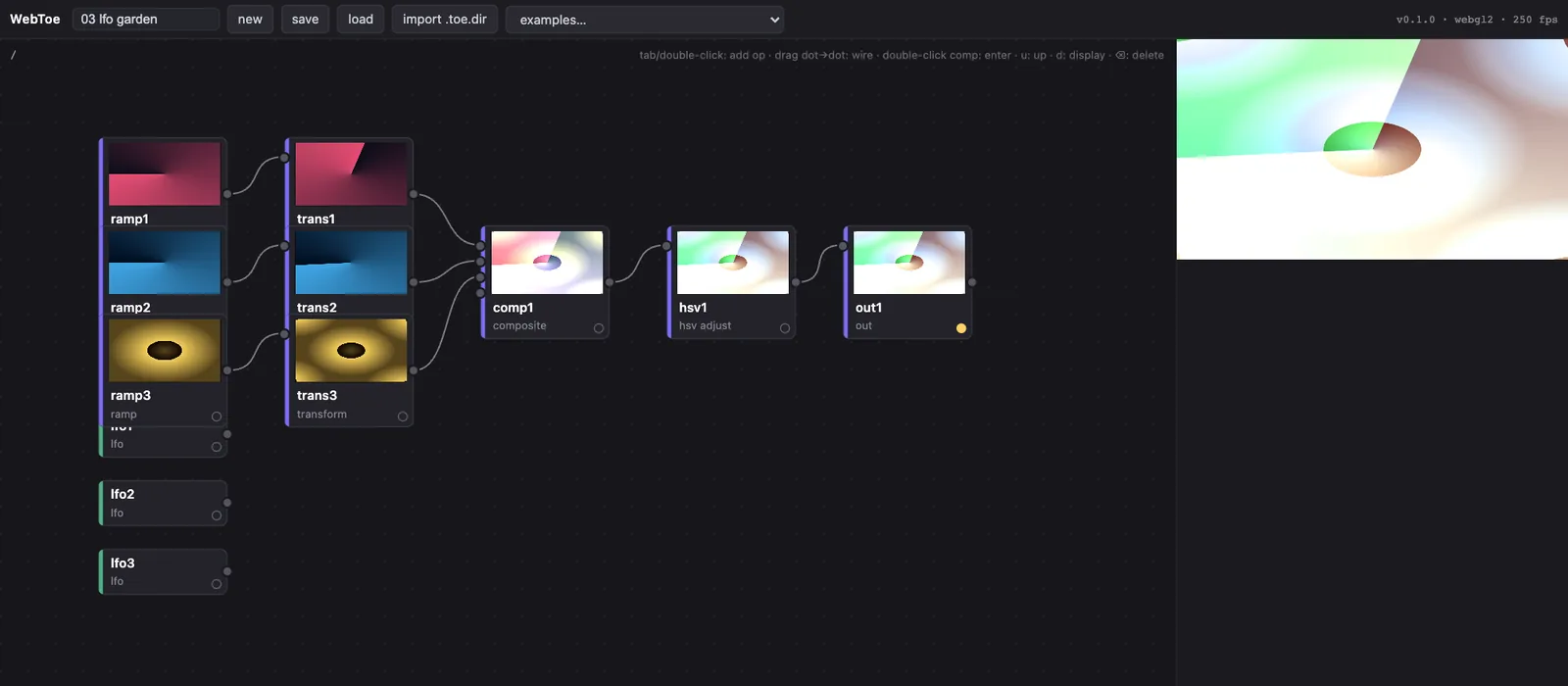
Patch operators together the way you would in TouchDesigner: a ramp through a transform into a composite, an LFO driving a parameter through an expression, a live preview on every node. WebToe is an original engine, built from scratch for the web on WebGL2 and WebGPU, and it opens your existing TouchDesigner projects.
WebToe is the engine, open-audiovisual is the show. A WebToe patch can be performed as an open-audiovisual world, and named signals map naturally onto CHOP channels.
01 · The engine
Patch it live, in a browser tab
A network editor, a real-time GPU engine, and a parameter panel where any value can be an expression. No install, no build step.
- of JavaScript for the whole app, with zero runtime dependencies
- ~90 KB
- two GPU backends at parity, behind one pass contract
- WebGL2 + WebGPU
- of 28,698 nodes from 60 real TouchDesigner projects are runnable: the measured corpus coverage
- 62.3%
- bundled projects that run out of the box, two of them raw .toe files saved by TouchDesigner in 2022
- 12
Numbers from the WebToe README, measured on real projects.
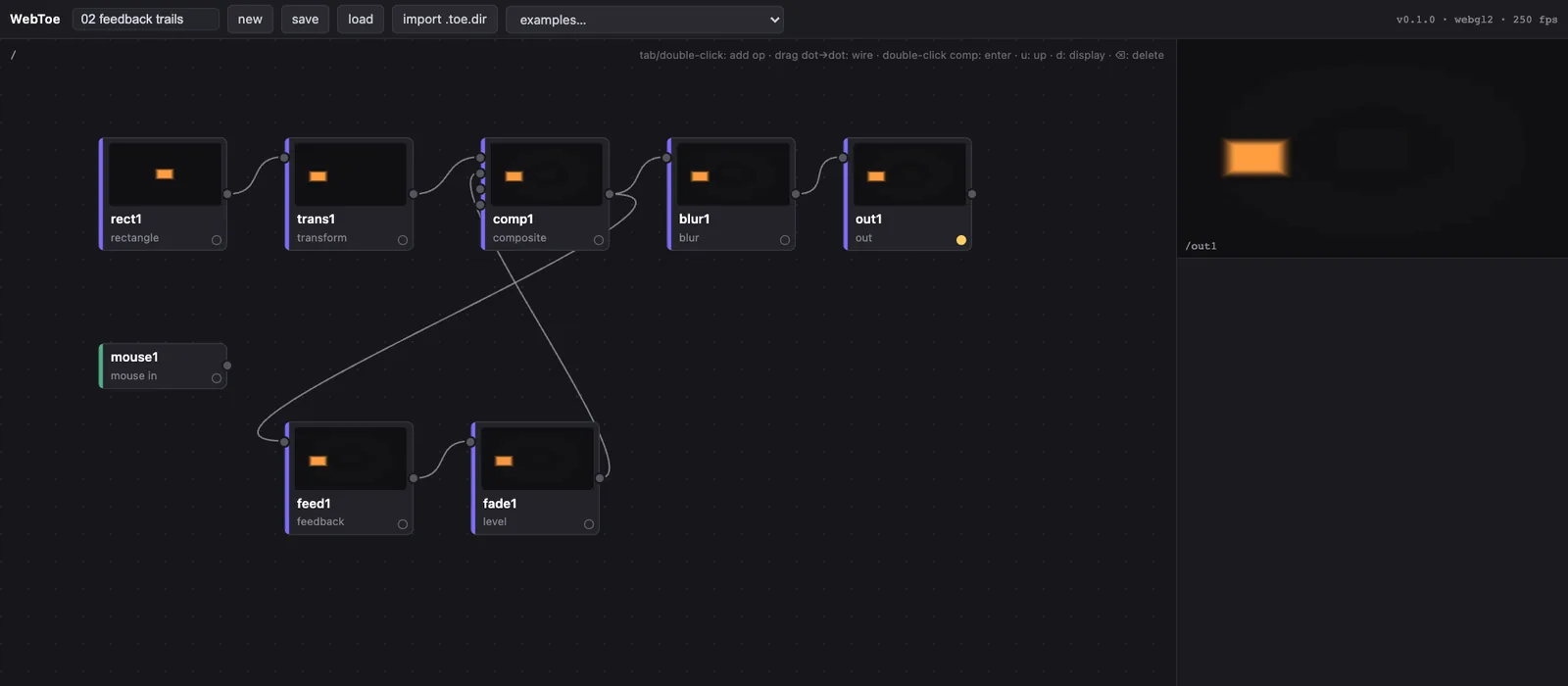
- Patch live. Press Tab to create an operator, drag wires, step into containers. Every node shows a real-time preview, and one GPU compositor paints them all at full frame rate.
- Expressions anywhere. Any parameter can be an expression:
op('lfo1')['chan1'],parent().par.speed,time.seconds * 0.2. - A real-time GPU engine. A pull-based cook loop. TOPs run as GPU passes and CHOPs drive parameters: feedback, blur, compositing, displacement, edge detection, webcam and video input, and a 3D pipeline with geometry, cameras, lights and a render TOP.
- Six operator families. TOP, CHOP, SOP, MAT, COMP and DAT. Projects save losslessly as
.webtoe.json, a versioned format of its own.
02 · With open-audiovisual
WebToe is the engine, open-audiovisual is the show
open-audiovisual brings the inputs, the mapping, the timeline and the backstage. WebToe draws. The adapter @openav/world-webtoe turns a WebToe patch into a world, so a knob, a chord or a hand can play it.
-
01 Signal
midi/cc/1Something happens on stage: a key is struck, a knob turns. It arrives as a named signal.
-
02 Param
midi/cc/1 → speedThe mapper routes the signal to a param of the world, with a curve and smoothing. The timeline can drive the same param.
-
03 Message
{ type: 'webtoe:ext', values }The world embeds the WebToe app in an iframe. Whenever a param moves, it posts the new values into it.
-
04 Patch
ext('speed', 0.5)Inside the patch, every parameter written with
ext()follows. The second number is the fallback while nothing is connected.
The show: a world that is a WebToe patch
Example 04, shortened. The param keys are the names the patch listens for. The project file is handed to the app as ?project=.
import { createShow } from '@openav/show';
import { webtoeWorld } from '@openav/world-webtoe';

await createShow({
  world: webtoeWorld({
    project: new URL('./garden.webtoe.json', location.href).href,
    // the keys are the names the patch listens for
    params: [
      { key: 'speed', min: 0, max: 1, def: 0.5 },
      { key: 'hue', min: 0, max: 360, def: 205 },
    ],
  }),
  routes: [{ source: 'midi/cc/1', target: 'speed' }],
});
Open example 04, WebToe stage → Source of @openav/world-webtoe ↗
The patch: parameters that listen
Two expressions from the example’s garden.webtoe.json. Put ext() into any parameter and it becomes playable.
// lfo1 · frequency
0.11 * (0.2 + ext('speed', 0.5) * 2.2)

// hsv1 · hueoffset
fract(ext('hue', 205) / 360 + time.seconds * 0.01)
Drive it from any page
These are plain postMessage calls, so any page that embeds WebToe can drive it. Values must be finite numbers. webtoe:load opens another project without reloading the frame.
const webtoe = iframe.contentWindow;   // an iframe showing the WebToe app

// set the values every ext('name') in the patch reads
webtoe.postMessage({ type: 'webtoe:ext', values: { speed: 0.72 } }, '*');

// open another project: a .webtoe.json or .toe URL the app may fetch
webtoe.postMessage({ type: 'webtoe:load', url: nextProjectUrl }, '*');03 · TouchDesigner projects
Drop a .toe and it opens
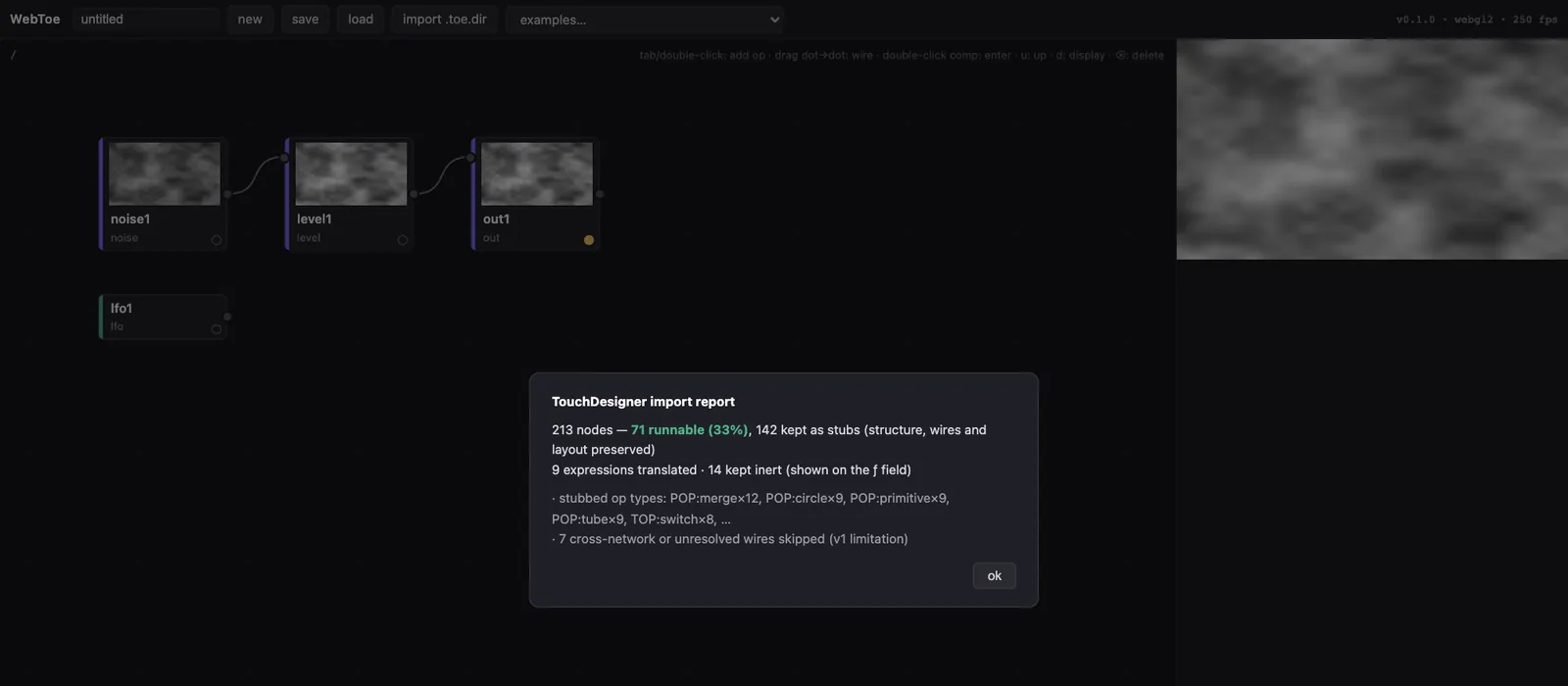
No install and no command-line step: WebToe decodes the TouchDesigner container right in the browser. Supported operators run live. Everything else becomes a stub that keeps its name, wires, layout, parameters and Python code, and an import report says what happened.
Validated against toeexpand
- 125 / 125
- production project files, 3 KB to 151 MB, decoded to identical file sets, byte for byte (553,230 files)
- 17.7 s
- to decode all 125 natively, against 266.5 s for TouchDesigner’s own
toeexpand - 4.2 s
- for a 151 MB show file. A daily sketch takes a few milliseconds.
- 8 s
- from drop to a running graph for a real 20 MB show file of 14,710 nodes
The reference path: your own TouchDesigner
If native decoding fails, WebToe falls back to the official toeexpand tool that ships with every TouchDesigner install, run on your machine through a small bridge. The bridge listens on 127.0.0.1 only and has zero dependencies. Your project files never leave your computer.
npx webtoe # the app, served locally with the bridge: drag your .toe inWebToe is an independent open-source project, not affiliated with or endorsed by Derivative Inc. TouchDesigner is a trademark of Derivative Inc. WebToe contains no Derivative code, binaries or assets.